
3 Ways to Use Authentic Materials for Speaking Practice With Young Learners
Speaking practice works best with topics that feel real, relevant, and enjoyable. Drills still have their place, but younger students are generally more engaged when they talk about things they recognize, experience, and (especially) enjoy. Authentic materials help to bridge this gap by providing real-world contexts for language use.
What Are Authentic Materials?
Authentic materials are real-world texts created within communities that use the target language. These include printed or published items designed for a general audience and used for a range of purposes, from entertainment and information to everyday communication.
Examples of materials include, but are not limited to, songs, radio and TV, leaflets, tickets, flyers, posters, and menus. The language used can vary from extremely casual, with emojis, to professional and academic. However, when selecting authentic materials, it’s crucial to ensure topics promote students’ willingness to communicate. This can be achieved this by making sure the topics are:
-
- Age-appropriate – Choose the topics that are relevant to your students’ age group and stage of development.
- Relatable – Pick themes that students can easily connect to, like daily activities, personal preferences and interests, or things they experience regularly.
- Comfortable and enjoyable – Select topics students can discuss confidently.
- Accessible – Ensure that materials are physically and/or digitally available to your students.
How can materials be used? In this blog, I will share three ways to encourage students to communicate using the target language with authentic materials.
Listen In and Discuss Events
Technology offers an incredible range of audiovisual content that can be used to practice both listening and speaking skills in the classroom. Many of these materials focus on sharing events, such as news reports, weather forecasts, TV shows, and more. Here’s an example of how these materials can be transformed into a speaking activity with a listening component:
Example Activity: Retelling Events Using the Past Tense
Focus: Practicing the past tense while retelling events and understanding sequence of actions.
-
- Choose a short audio or video clip from a news report (suitable for children), weather forecast, or TV show that focuses on an event or takes place at a specific time (E.g., a weather update, a school event, or a news story about something students can relate to).
- Play the short clip and allow them to listen (and/or watch).
- Have students retell the event, using past tense.
- Encourage them to focus on the sequence of events (E.g., first, then...)
- Invite students to share as a class with questions like, “Can anyone tell the class what happened?”
- After retelling the event, ask students another follow-up question to discuss or plan related to the clip date or event to encourage more group or class discussion. Possible questions could include:
- What would you do on [date/season/weather]?
- Would your day be similar to or different from the one in the clip?
Various devices can be used to access these materials, whether it’s through a radio, smartphone, laptop, or classroom projector. To ease students into the listening practice, consider using live broadcasts as a challenge, and also taking advantage of recordings with options to pause, repeat, and adjust playback speed for scaffolded support. If available, transcriptions or captions can provide additional reading support alongside the listening and speaking practice.
Read and Decide
Text-based materials can be easily categorized based on location or setting, creating opportunities for students to engage with specific topics that are directly relevant to their lives, hobbies, or class content.
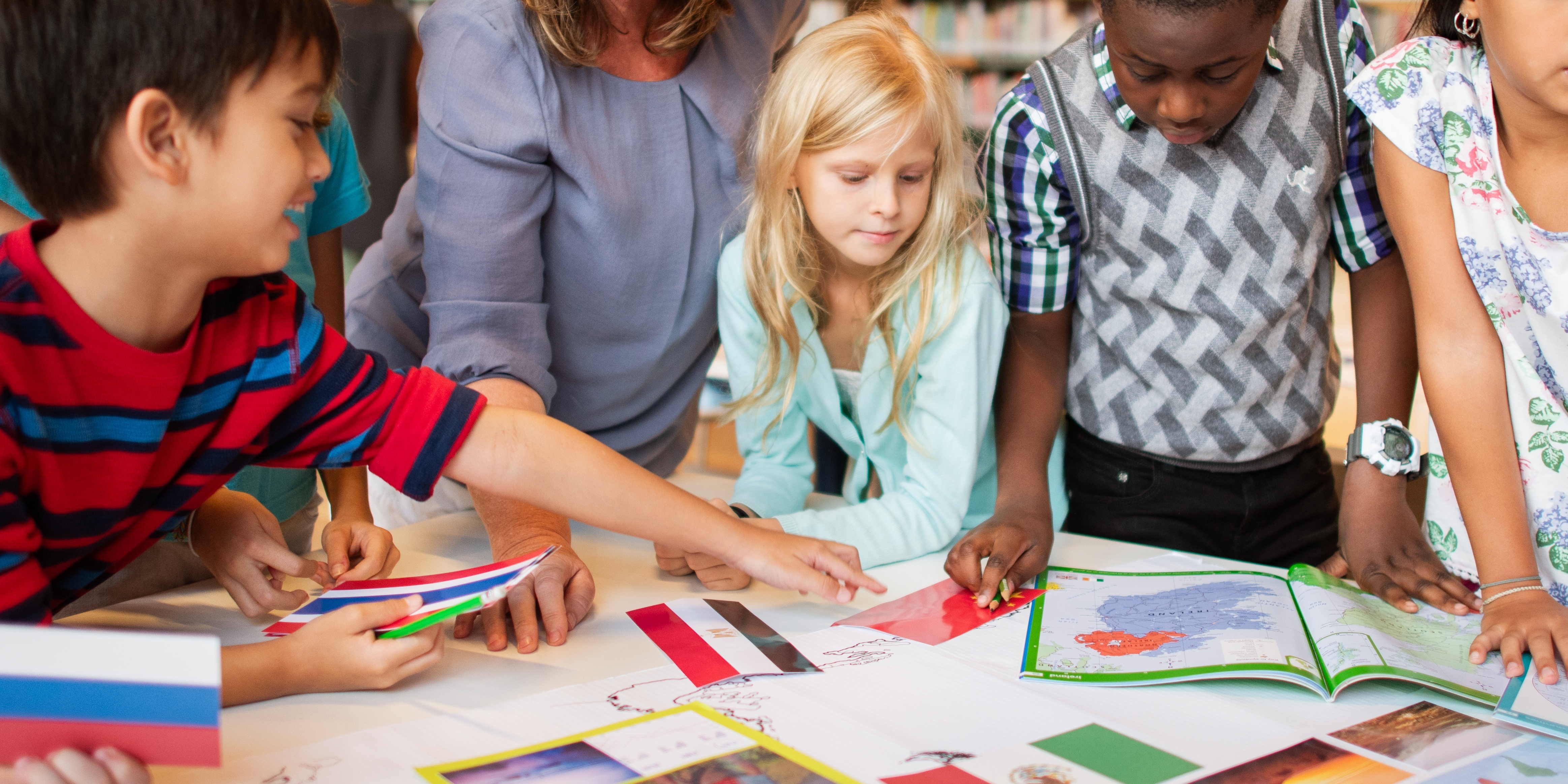
By using materials like menus, event flyers, and maps, students can practice making decisions, expressing preferences, and discussing their choices, all while expanding their vocabulary in areas such as food, shopping, and/or entertainment. Here are some examples of categories suitable for younger learners:
|
Location |
Materials |
Language Use |
Example Questions |
|
Classroom and School |
Posters, timetables, notice board, newsletter |
Asking questions, talking about subjects, making plans |
What subjects do you have today? What is happening next week? What is on the ___?
|
|
Shops and Markets |
Store catalogs, product advertisements, store flyers, price tags
|
Asking about prices, describing objects, choosing items, expressing opinions |
How much is ___? What is special today? Which one would you buy? |
|
Restaurants and Cafés |
Menus, food advertisements, labels, restaurant reviews |
Ordering food, talking about favorite foods, different food options
|
Where do you like to eat? What would you recommend? How much is ___? |
|
Parks and Roads |
Park signs, maps, brochures |
Asking for directions, talking about places, Making plans
|
Where is the park? What can we do here? Where do you want to go? |
|
Sports and Leisure |
Procedures, magazine or news articles, maps, brochures, game instructions
|
Giving game rules, asking for advice, talking about scores or game plays, comparing activities
|
How do you play this ___? Where can you ___? Which ___ do you prefer? |
Placing a selection of these resources on different tables around the classroom can encourage students to discuss a variety of topics based on their surroundings.
Share and Ask Questions
Once students are familiar with a variety of authentic materials, you can invite them to share their own items with the class to encourage more meaningful language use. Students can choose any item—whether it’s a ticket or brochure from a recent trip, a magazine article they recently read about one of their interests, or a TV show clip from one of their current favorites—and present it to the class.
To help students prepare, encourage them to describe their item, explain where it came from, and share why it’s interesting to them. To support their presentation, provide sentence starters like:
-
- I bought it because...
- It’s from...
Remind students that questions can be asked once the presenter says, “Do you have any questions?” Some students presenting may ask the question right after their presentation starts, and that is okay. The follow-up questions from everyone in the classroom can help prompt even more meaningful language use. Some possible follow-up questions sentence starters include:
-
- Where did you…?
- When did you…?
- Can you tell us more about…?
Sharing and asking questions can be a great way for students to practice real-world communication in a supportive and dynamic environment.
It is no surprise that there are a lot of authentic materials readily available—from posters and tickets to news articles and video clips. These three activity ideas are only a few of the many ways authentic materials can be transformed into a prompt for meaningful group or class discussions. When you get a chance, take a look around and see what materials you can use—anything real, relevant, and enjoyable—to inspire even more meaningful speaking practice.
 Happy Teaching and Learning!

About the author
Annita Stell
Annita balances her roles as a writing instructor for younger multilingual learners of English and an academic at the University of Queensland, Brisbane, Australia. As the author of the TESOL No-Prep Activity Cards: Literacy—Small cards, Big impact—she enjoys making learning fun and not a chore through combining creativity, scholarship, and innovation. Her research focuses on the impact of mediation, self-regulation, and collaboration on second language development.