
Grammar as a Tool for Confidence: Beyond Simple Sentences

In my first TESOL blog, I focused on helping multilingual learners of English MLEs build confidence through simple sentence writing, personal pronouns, and the present simple tense. After helping my students build their confidence with these basics, I found that many were still nervous about writing complete ideas in English. Some wrote slowly because they feared making mistakes. Others kept looking at classroom charts before writing each word.
I still remember one student sitting quietly for several minutes, his pencil in hand, before writing one sentence. He finally wrote:
“I play soccer.”
When I asked him to read the sentence aloud, he looked nervous and spoke very softly. A few weeks later, the same student confidently wrote:
“I play soccer with my friends after school.”
That growth mattered. The sentence was longer, but more importantly, the student trusted himself to express a complete thought in English. After several weeks of practice, I noticed students becoming more comfortable taking risks with language. The classroom slowly became more interactive as students read sentences aloud, helped classmates, and shared ideas more freely.
TIP: Before writing activities, I usually provide students with a short list of verbs and prepositions, each with translations into their home languages. This support helps students organize their ideas before writing. When students become more independent, I gradually remove support, so they rely more on their own vocabulary.
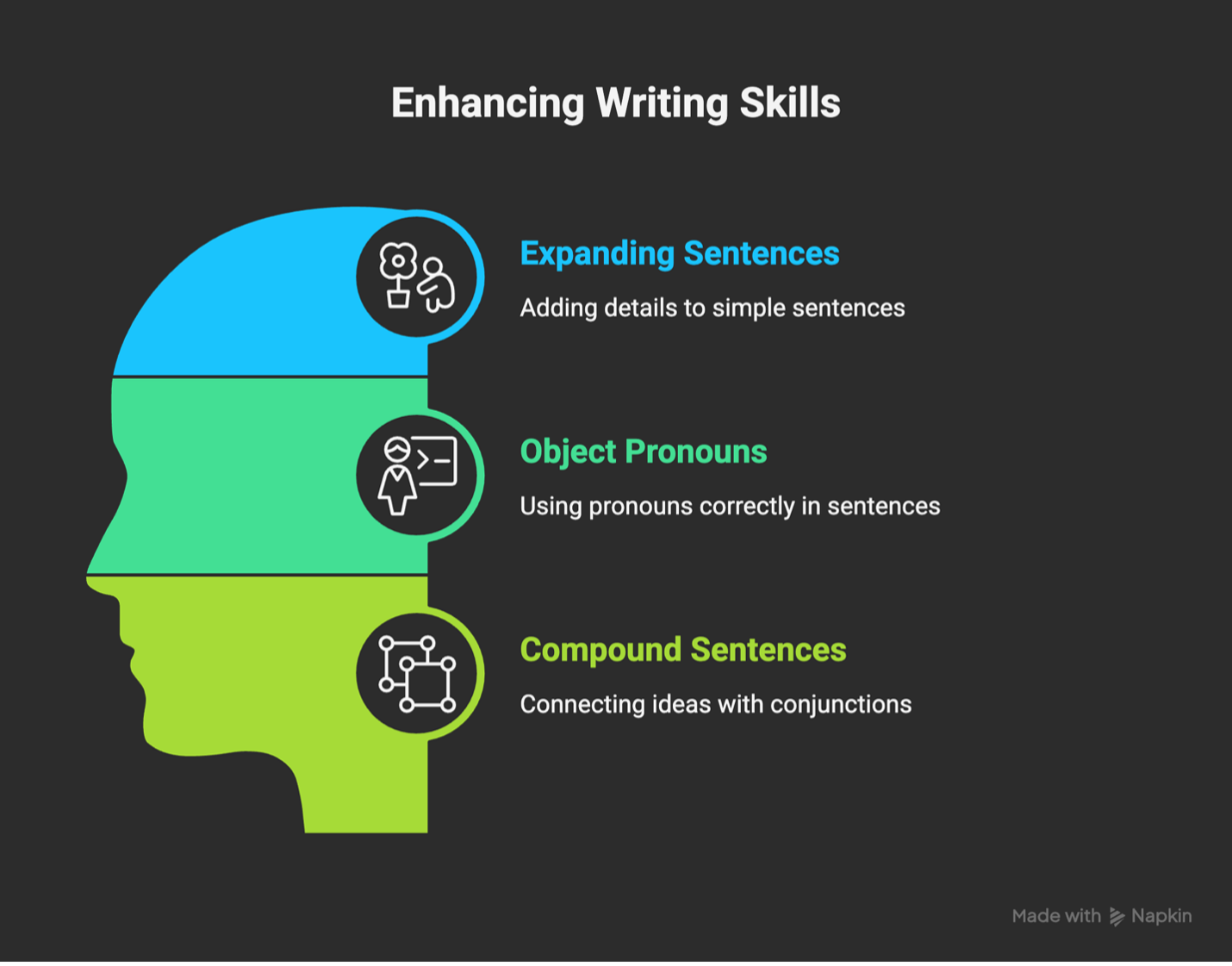
1. Expanding the Subject-Verb-Object Sentence
In the first blog, my students practiced writing simple Subject-Verb-Object sentences, such as:
-
- “The student writes an essay.”
- “The teacher explains the lesson.”
Once students become comfortable writing complete sentences, I help them expand their ideas. Many MLEs believe short statements are safer because they think longer ones lead to more mistakes. I show students that adding details makes communication clearer.
I usually start with a very short sentence on the board:
“She runs.”
Then, together, we slowly build the sentence, step by step:
-
- “She runs fast.”
- “She runs fast in the morning.”
- “She runs fast in the morning because she is training for a race.”
Students often become excited when they see how a short sentence can unfold into a detailed idea. Sometimes they laugh when the sentence becomes long because they realize they created it together as a class.
One student wrote:
“I study.”
After practicing sentence expansion, he revised the sentence to:
“I study quietly at night because I want to become a doctor.”
That sentence sounded more personal and meaningful. The student was no longer writing to complete an assignment. He was expressing a real goal and sharing part of his life through writing.
Activities to Try
The Sentence Expansion Activity: Start with one short sentence and ask students to add one detail at a time. Use guiding questions such as:
-
- “Where?”
- “When?”
- “Why?”
- “How?”
From writing to speaking: After expanding their sentences, students read them aloud to a partner. This helps connect writing with speaking naturally.
Sentence ladder activity: Students begin with one short sentence and pass it to a partner. Each partner adds one more detail to make the sentence longer and more descriptive.
Story extension practice: Give students the beginning of a sentence, such as “I study after school…” and ask them to carry on the idea using their own experiences.
2. Moving From Subject Pronouns to Object Pronouns
In the first blog, my students practiced replacing repeated nouns with subject pronouns:
-
- “Maria is my friend. She is kind.”
- “The students are working. They are studying.”
Once students become comfortable with subject pronouns, I introduce object pronouns. Students begin creating smoother sentences that sound more natural in both writing and speaking.
I usually model simple examples first:
-
- “The teacher helped him.”
- “I called her.”
- “We invited them.”
Then we compare subject pronouns and object pronouns together:
-
- “She helped me.”
- “I helped her.”
Students sometimes confuse subject and object pronouns at first. Instead of focusing only on correction, I encourage them to read sentences aloud because hearing them helps notice what sounds natural.
One student wrote:
“My friend helped my friend with homework.”
Together, we revised the sentence:
“My friend helped her with homework.”
When the student read the revised sentence aloud, he smiled because it sounded much more fluent.
Activities to Try
Pronoun replacement activity: Write sentences with repeated nouns and ask students to replace the nouns with subject or object pronouns.
Partner conversations: Students practice asking and answering simple questions, such as:
-
- “Did you help him?”
- “Yes, I helped him yesterday.”
Read-aloud flow check: Ask students to read sentences aloud and listen to whether the pronouns sound natural.
Pronoun card activity: Prepare cards with nouns and matching pronouns. Students work in pairs to match the correct pronouns and create sentences aloud.
Classroom interview activity: Students ask classmates simple questions using object pronouns, such as “Did your teacher help you?” or “Did your friend call her?” Then students share their responses with the class.
3. Moving From Present Simple Tense to Compound Sentences
Once students become comfortable writing present simple sentences independently, I help them connect ideas using conjunctions. This is when students often become more fluent by expressing connected thoughts rather than isolated sentences.
I usually begin with two quick sentences on the board:
-
- “She was tired.”
- “She finished her homework.”
Then I ask students: How can we connect these ideas? Together, we build:
“She was tired, but she finished her homework.”
We practice using conjunctions such as and, but, and so. Students quickly realize they can explain relationships among ideas instead of listing separate thoughts. Many enjoy reading their longer sentences aloud because they sound complete and more natural.
One student began with:
“I study English. I want to go to college.”
Later, the student revised the sentence to:
“I study English so that I can go to college.”
The sentence sounded better connected and more confident. The student was no longer writing disconnected ideas but communicating a purpose.
Activities to Try
|
Conjunction Bank F – for |
Sentence-Combining Activity: Give students two short statements and ask them to combine the ideas using conjunctions.
Speak what you write: After combining sentences, students read them aloud to hear how connected ideas improve speech flow.
Daily routine connection activity: Students write two present simple sentences about their routines and combine them into one compound sentence.
Partner speaking challenge: One student says a simple sentence. The partner continues the idea using a conjunction to create a compound sentence.
Conclusion
One of the most rewarding parts of teaching grammar is watching students move from short, hesitant sentences to meaningful communication. Small expansion of ideas may seem trivial, but they matter deeply in the classroom. Students begin trusting their own voices. Once confident in expressing themselves in English, they become more willing to participate, speak, write, and share ideas openly.

About the author
Karuna Dwivedi
Karuna Dwivedi, EdD, is an English language learning specialist, higher education educator, and author of Grammar as a Bridge: Empowering ELLs Through Writing and Speaking. She earned her doctorate in English language learning from National University and holds Cambridge CELTA and TESOL/TEFL certifications, with teaching experience from high school through university. Her research uses a qualitative phenomenological design with interpretative phenomenological analysis, grounded in culturally responsive pedagogy and Vygotsky’s sociocultural theory, to advance equitable, asset-based support for multilingual learners.