
No-Fear Grammar: Instill Confidence and Create Space for Language Growth

When students are learning English, grammar often becomes one of the most stressful parts of the classroom experience. Many multilingual learners of English (MLEs) want to participate, share ideas, and take academic risks, but they worry about making mistakes. I have worked with students who hesitate before speaking because they try to mentally organize every sentence first. Others keep their writing very short because they’re afraid their errors will be judged more than their ideas. Over time, that fear can make students feel disconnected from language learning.
Grammar as Support Instead of Correction
I do not believe grammar itself causes this problem. More often, the issue comes from how grammar is taught. When instruction focuses mostly on correction, students begin to associate grammar with failure. They stop seeing it as a tool for communication and instead view it as something that exists only to point out what they did wrong. In many classrooms, MLEs already feel pressure when speaking or writing in English, so constant correction can make that anxiety even stronger.
At the same time, grammar still matters. Students need structure to communicate clearly and confidently. Grammar gives learners a way to organize their thoughts and connect ideas in meaningful ways. Without that structure, students often rely on very short responses or avoid participating altogether because they are unsure how to express themselves. I have noticed that when students begin understanding sentence patterns and language structures, they usually become more willing to contribute during discussions and in writing activities.
Writing Creates Space for Language Growth
For many learners, writing becomes the safest place to develop language. Writing gives students time to think carefully about what they want to say. Unlike speaking, there is no immediate pressure to respond. Students can reread sentences, make adjustments, and experiment with language. That process is important because it allows grammar to become practical rather than abstract. Instead of memorizing isolated rules, students begin using grammar to communicate real ideas.
I have also seen a strong connection between writing and speaking development. Students who regularly practice sentence structures in writing often begin using those same structures naturally in conversation. Their confidence grows because they are no longer guessing how sentences work. The language becomes more familiar through repetition and meaningful use. Speaking starts to feel less intimidating because they already practiced the language privately on paper first.
This is one reason I encourage teachers to rethink how grammar instruction is approached in classrooms with MLEs. Instead of immediately focusing on errors, it helps to first ask whether students have the language tools they need to express their ideas. That small shift changes the classroom atmosphere significantly.
Students become more willing to participate when they feel their ideas are valued before their mistakes are corrected.
Grammar instruction becomes much more effective when it connects to meaningful communication. Students engage more when they are writing about their own experiences, routines, families, opinions, or goals. In those moments, grammar supports communication rather than interrupting it. Learners begin to see language as useful and personal, rather than something designed solely for academic evaluation.
Mini-Lesson: Foundations and Personal Pronouns
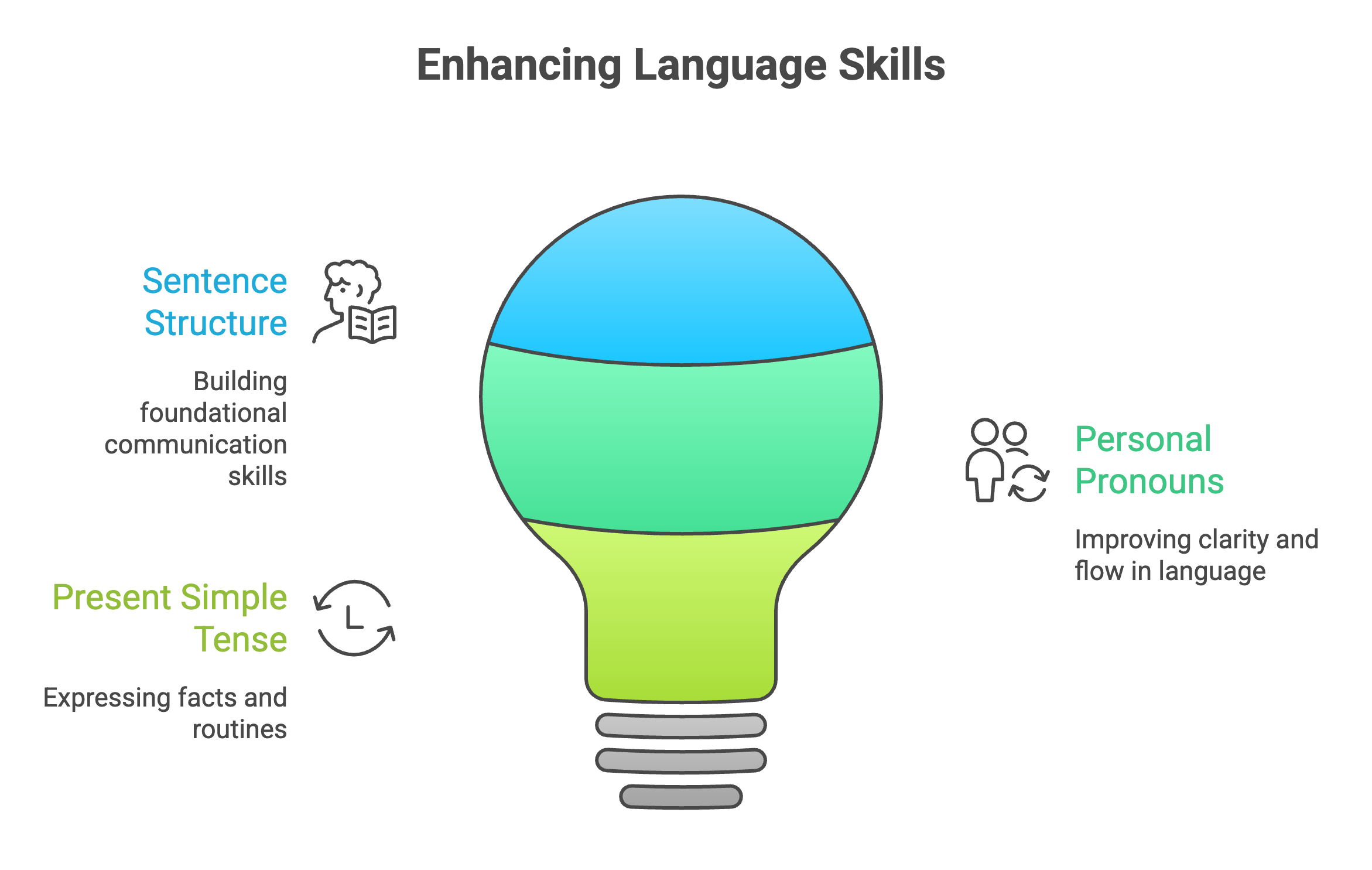
1. Sentence Structure (Simple): Using the Subject–Verb–Object (SVO) Anchor
One of the first things I focus on with MLEs is helping them understand basic sentence structure. Many students benefit from seeing how sentences are organized visually before they are expected to produce longer academic writing. I usually begin with simple Subject–Verb–Object sentences because they provide a clear foundation students can build on later.
For example, I might write a sentence like “The student writes an essay” on the board. Then we identify the subject, the verb, and the object together. Breaking sentences apart visually often helps students understand how ideas are connected. Once they understand the structure, they usually become more comfortable creating their own sentences.
Activities to Try
Word cards: Hand out flashcards with different subjects, verbs, and objects. Let the kids build and swap them around. Keep it entertaining and interactive.
The expansion game: Start with a simple sentence and build on it as a class, step by step. Add a time, a location, or a feeling. Watch the sentence evolve on the board.
From pen to voice: Have them write a quick sentence and then read it out loud right away. That instant of moving from the page to their own voice is usually when everything finally clicks.
2. Personal Pronouns: Replacing Repetitive Nouns
Personal pronouns are another important area for MLEs because they help writing sound smoother and more natural. Students often repeat the same noun several times because they are unsure when to use a pronoun instead. Instead of treating pronouns as another grammar rule to memorize, show students how they improve communication. Pronoun practice also improves speaking fluency. When students become comfortable replacing repeated nouns naturally, their speech tends to sound more fluid and confident. Small language adjustments like these can make a significant difference in how comfortable students feel using English in conversations.
Activities to Try
Before-and-after fix: Give your class a short text full of repeated nouns and have them clean it up. This immediate transformation is always satisfying for them.
Quick matching game: Pair up nouns with their corresponding pronouns. This is a simple activity that sticks in their minds.
Read-aloud for flow: Have students retell a brief paragraph aloud, focusing on pronoun use. When the rhythm clicks, they will notice it right away, and that moment is the lesson's point.
3. Present Simple Tense: Expressing Facts and Universal Truths
The present simple tense is often a good starting point for MLEs because it allows students to talk about familiar topics right away. Students can describe routines, facts, and everyday experiences using language that feels manageable. This helps reduce anxiety because learners can focus more on communication than complicated verb forms.
Activities to Try
Daily routines: Get your students writing about their own lives using the present simple. When they describe things they actually do, the grammar tends to make sense much faster.
Verb tracking game: Do a quick "verb hunt" through a sample paragraph together. Have the class find the action words and check the subject-verb agreement. It’s significantly more engaging than just completing a worksheet.
Pair share: Have students share their written sentences out loud with a classmate. Moving a thought from the page to actual speech is usually the best way to help them really understand what they've learned.
Conclusion: Grammar as a Pathway to Voice
Grammar instruction should help MLEs feel more confident using language, not more afraid of making mistakes. Confidence usually develops through small successes that build over time. When students are given time to write, reflect, and practice language in supportive environments, they often become more willing to speak and participate academically.
I believe grammar works best when it is connected to communication, writing, and student voice. Learners need opportunities to experiment with language without feeling constantly judged for errors. When grammar becomes a support for expression rather than a source of fear, students participate more openly and begin to develop greater confidence in both writing and speaking.
For MLEs, finding their voice in English is not only about memorizing rules. It is about feeling safe enough to communicate ideas, take risks, and grow through practice. Grammar can play an important role in that process when it is taught with patience, purpose, and meaningful support.

About the author
Karuna Dwivedi
Karuna Dwivedi, EdD, is an English language learning specialist, higher education educator, and author of Grammar as a Bridge: Empowering ELLs Through Writing and Speaking. She earned her doctorate in English language learning from National University and holds Cambridge CELTA and TESOL/TEFL certifications, with teaching experience from high school through university. Her research uses a qualitative phenomenological design with interpretative phenomenological analysis, grounded in culturally responsive pedagogy and Vygotsky’s sociocultural theory, to advance equitable, asset-based support for multilingual learners.