
From Simple Sentences to Expanded Ideas: Grammar Strategies for MLEs

In my previous post, we focused on using grammar as a tool to build students' confidence and support their voices. As your multilingual learners of English begin to feel more secure in their language use, your next step is to guide them toward expansion. At this stage, students are ready to move beyond forming correct sentences as well as begin expressing more detailed and connected ideas. You may notice that your students can produce simple or connected sentences, but they struggle to extend them further. This is not necessarily a lack of grasping the language but more likely a need for organized support. Expanding grammar instruction allows you to help students build depth, add detail, and communicate more fully.
Moving Beyond Basic Connections
Your students may already be using compound sentences to connect ideas. Now your role is to help them expand those connections by adding detail, layering information, and varying sentence form. This shift moves students from combining ideas to developing them. When students learn to extend sentences, they begin to express relationships more clearly. Grammar supports this process by helping learners organize ideas with finer precision. This is where language begins to express deeper thinking.
Using Writing to Support Expansion
Continue using writing as a structured space for practice. Writing allows your students to experiment with extending sentences, adding detail, and refining meaning free from the pressure of quick deadlines. This supports deeper processing and reduces hesitation. Once students become more comfortable extending their sentences in writing, you will begin to see these patterns appear in their speaking. This gradual transfer supports more effortless communication and increased participation.
💡 TIP
Before assigning writing activities, provide students with a short list of verbs and prepositions, along with translations in their home languages when possible. This support helps students organize their ideas and reduces mental effort. When students become more independent, gradually remove this support so they rely more on their own vocabulary.
 Viewing Grammar as Growth
At this stage, grammar represents growth more than mastery. Your students do not need perfect sentences, but they do need opportunities to expand their ideas. When you position grammar as a way to say more, students interact more actively. They begin to add detail, clarify meaning, and express more complete thoughts. Your role is to guide this expansion through intentional instruction.
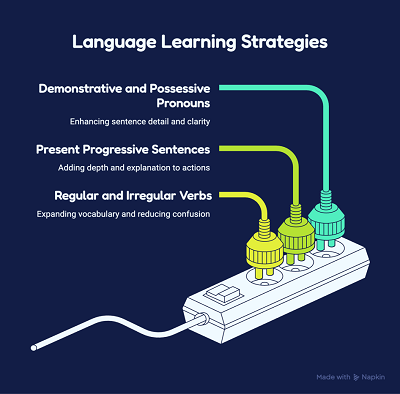
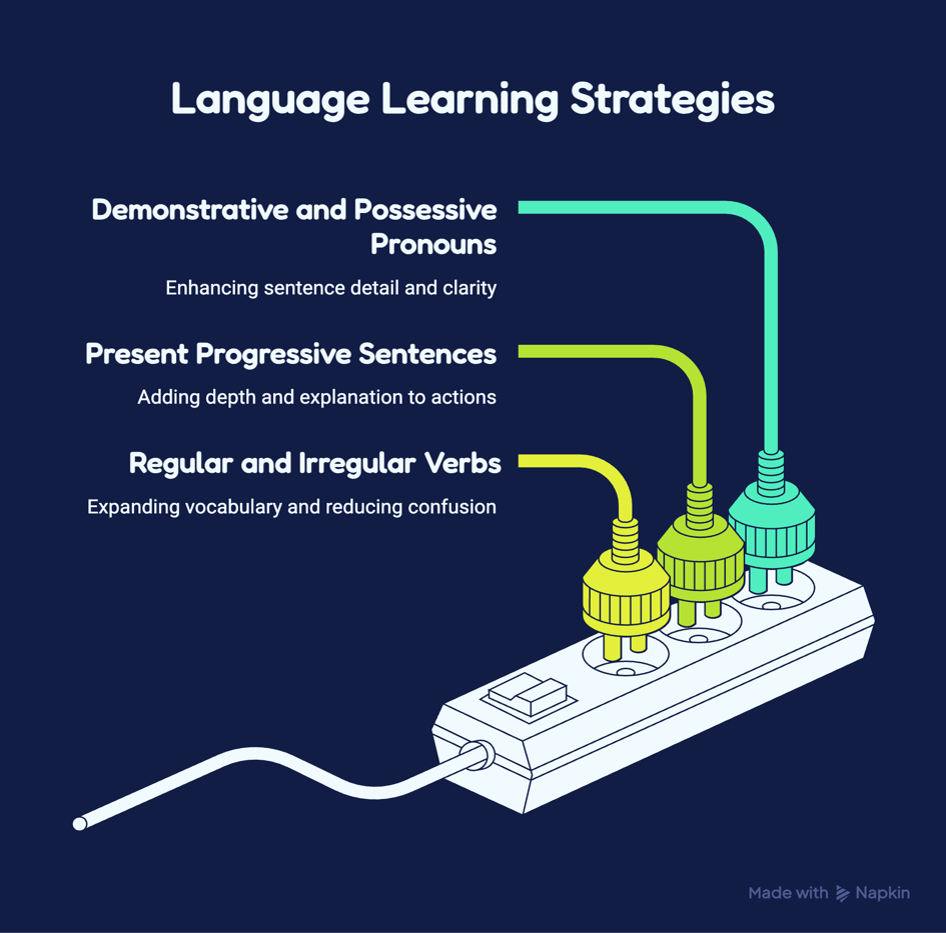
1. Demonstrative and Possessive Forms
Extend your students’ understanding of pronouns by combining demonstrative (this, that, these, those) with possessive forms (my, your, his, her, our, their). This helps learners clarify meaning by adding detail.
Model how students can expand ideas:
“This is my book.” → “This is my book, and it is on the table.”
This step moves students from identification to expanded description.
Activities to Try
-
-
- Students describe objects using demonstrative and possessive forms, then extend the sentence with additional detail.
- Students write two related sentences, then combine them into one expanded sentence.
- Students explain their sentences orally, focusing on intelligibility of expression.
-
2. Present Progressive With Expanded Sentences
Move beyond basic compound sentences by helping students extend ideas within and across sentences using the present progressive tense. Instead of simply connecting two actions, guide students to add detail or explanation.
Model progression:
“She is writing” → “She is writing, and she is using a blue pen because she likes it.”
This helps students move from simple connection to layered meaning. Encourage students to replace basic verbs with more specific ones:
“She is doing her homework.” → “She is completing her homework.”
This strengthens both clarity and vocabulary development.
Activities to Try
-
-
- Students write present progressive sentences, then expand them by adding reasons or details.
- Students extend a sentence by answering “how,” “where,” or “why.”
- Students read expanded sentences aloud to practice fluency.
-
3. Regular and Irregular Action Verbs
Introduce regular and irregular action verbs to help your students expand their ability to express a wider range of actions. Explain that regular verbs follow a predictable pattern when forming the past tense (typically adding -ed, such as walk → walked), while irregular verbs do not follow this pattern and must be learned individually (such as go → went, eat → ate). Highlighting this difference helps students observe patterns and reduces confusion when forming sentences.
Model examples and guide students to notice these patterns in context. This supports both understanding and accurate usage in communication.
Activities to Try
-
-
- Provide a list of regular and irregular verbs and ask students to sort them into two categories based on their patterns. (Here is a list from Duolingo with pronunciation.)
- Have students write sentences using both regular and irregular verbs in present and past forms.
- Students write sentences using a mix of regular and irregular verbs.
- Students describe actions orally using varied verbs.
-
Introduce a wider range of regular and irregular verbs and provide opportunities for students to recognize and use their different forms. This helps students build familiarity with common verb patterns and use past-tense forms accurately.
-
- Regular: “She walks to class every day.” → “She walked to class yesterday.”
- Regular: “They play soccer after school.” → “They played soccer yesterday.”
- Irregular: “She goes to class every day.” → “She went to class yesterday.”
- Irregular: “They eat lunch at school.” → “They ate lunch at school yesterday”
Conclusion
As your students move beyond basic structures, your instruction should focus on helping them expand what they can say. Grammar adds detail, connects ideas more deeply, and expresses meaning more clearly. When you support this level of expansion, your students begin to communicate with increased confidence and flexibility. Grammar continues to function as a bridge—now helping learners move from basic connections to increasingly meaningful and developed expression.

About the author
Karuna Dwivedi
Karuna Dwivedi, EdD, is an English language learning specialist, higher education educator, and author of Grammar as a Bridge: Empowering ELLs Through Writing and Speaking. She earned her doctorate in English language learning from National University and holds Cambridge CELTA and TESOL/TEFL certifications, with teaching experience from high school through university. Her research uses a qualitative phenomenological design with interpretative phenomenological analysis, grounded in culturally responsive pedagogy and Vygotsky’s sociocultural theory, to advance equitable, asset-based support for multilingual learners.