
Grammar Activities for More Expressive Speaking and Writing, Part 1

Picture a student in class who is fluent in more than one language and would like to share an experience with the class. Although they know what they want to say, it does take some time to work out the exact words. They start off with a basic sentence: "I study English." When the teacher asks them for more information, the student pauses, taking time to think of the words needed to describe how long they have been learning the language, the difficulties they have encountered, and the way their confidence has changed.
It is a usual difficulty for people learning English. Although many students have worthwhile experiences, opinions, and knowledge, they often don't possess the grammatical skills needed to express them completely. For instance, a student might know the word difficult yet still struggle to describe a difficult experience. Or they might understand the concept of time but not know how to explain the relationship between past and continuing actions. The issue isn't that they lack ideas, but rather that they need the appropriate language tools in order to make their ideas clear.
In my previous blog post, I looked at the way in which compound sentences can help multilingual learners of English to connect their ideas and go beyond simple statements. In this article, however, I am concentrating on the ways in which adjectives, the perfect continuous tenses, complex clauses, and transitions can help students to describe, reflect, explain, and take a more active part in expressing themselves. By using practical speaking and writing exercises, teachers can help students move beyond merely forming correct sentences and begin to share their own experiences, knowledge, and voices.
1. Adjectives for Adding Meaning and Detail
Adjectives enable students to describe people, places, emotions, and experiences more precisely. Compare “The student gave a presentation” with “The confident student gave an informative presentation.” The second sentence gives the listener more detail. Help students notice how adjectives appear before nouns or after linking verbs, as in “The assignment was challenging,” and apply these patterns in their own writing.
Activity: Describe, Visualize, and Explain
Goal: Use adjectives to improve descriptive writing and spoken descriptions.
Focus on Writing
-
- Show a photograph of a classroom, library, park, or community space.
- Ask students to write three simple sentences about the image.
- Provide an adjective word bank and model how to expand a sentence.
- Have students revise their sentences using at least four adjectives.
Example
-
- Starting Sentence: The library has some tables.
- The spacious library has comfortable tables.
- The spacious, quiet library has large, comfortable tables.
Writing Assessment: Ask students to hand in both their original and revised sentences. Evaluate their correct use of adjectives, the clarity of their descriptions, and their ability to include meaningful details. For their exit task, students should revise another simple sentence and then give a short explanation of how their choice of adjectives had improved the description.
Focus on Speaking
-
- Give each student a photograph of a classroom, library, park, or community space. You can also have students bring a picture from home of a location.
- The students work in pairs and take turns without showing each other their pictures. One student starts by saying one basic sentence to describe the image, then adds adjectives to describe the image in more detail while the other listens and either draws it or attempts to guess the setting.
- Students compare their results and discuss which of the descriptive words had made the communication clearer.
💡 TIP
Give beginning learners illustrated word banks and sentence frames. Ask more advanced learners to make their descriptions more precise and explain their word choices.
Speaking Assessment: When students are describing their pictures to their partners, observe them to find out how clearly and accurately they use adjectives in communicating the visual details and in helping their partners to draw or identify the images. Once they have compared their results, get the students to explain which descriptive words were most effective and give the reasons for this.
2. Present Perfect Continuous and Past Perfect Continuous
Once students can add descriptive detail, they can begin to explain how long an activity has lasted and how it relates to other events. The present perfect continuous links an activity that began in the past with the present or a recent result. The past perfect continuous describes an activity that was ongoing before another past event. Understanding the difference helps students to describe their experiences more clearly.
|
Tense |
Structure |
Example |
|
Present perfect continuous |
have/has + been + verb-ing |
I have been studying English for three years. |
|
Past perfect continuous |
had + been + verb-ing |
I had been studying English for three years before I entered university. |
Use timelines to show the difference. “I have been preparing for my presentation since Monday” connects the preparation with the present. “I had been preparing for two weeks before I delivered my presentation” shows the duration of preparation before a past event.
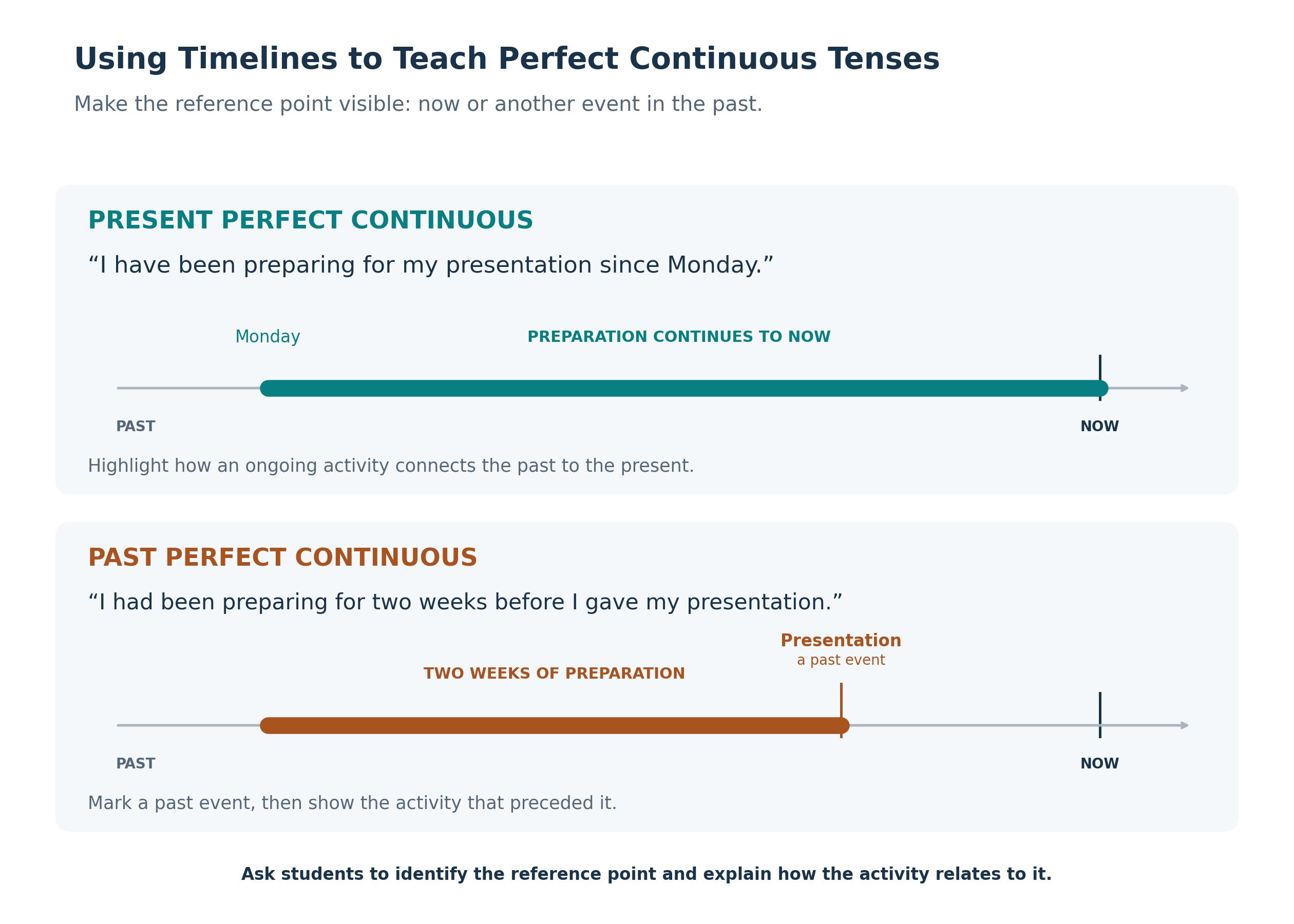
Graphic created by ChatGPT.
Activity: My Learning Journey, Then and Now
Goal: Using the present perfect continuous and the past perfect continuous, write a short personal narrative, ask and answer questions about the duration and sequence of personal experiences, and orally summarize a partner’s learning journey.
Focus on Writing
-
- Have students create a timeline of their schooling, hobbies, or language learning.
- Model both tenses, then ask students to write two sentences using each tense.
- Have students combine their sentences into a short narrative and exchange feedback with a partner.
Sentence Frames
-
- I have been studying ______ for ______.
- I have been doing ______ since ______.
- Prior to my ______, I had been ______ for ______.
- When ______ happened, I had already been ______ for ______.
Model Narrative
I have been learning academic English for two years, and I have been giving presentations to build my confidence. Before I joined my current program, I had been teaching myself English for several months. I had been preparing my speech for two weeks before I gave my first presentation.
Writing Assessment: Ask students to submit their learning journey narratives using the present perfect continuous and the past perfect continuous tenses. When assessing their work, check that the tenses have been used correctly, that the events have been properly sequenced, and that their experiences have been clearly described. They should revise one sentence in response to the feedback from their partner and then explain how this revision has improved their writing.
Focus on Speaking
-
- Students take turns as interviewer and interviewee.
- They ask questions such as “How long have you been studying English?” and “What had you been doing to prepare before your first presentation?”
- After switching roles, they provide a brief summary of their partner’s learning journey.
💡 TIP
Beginning learners can use color-coded timelines and sentence frames. More advanced learners can explain more complicated sequences and discuss how changing the tense changes the meaning.
Assessment: When interviewing their partners, observe the students and have them summarize each other’s learning journeys. Check their ability to use both tenses correctly, to ask appropriate questions, and to clearly describe the duration and sequence of the events. As a final step, get the students to explain orally the difference between the two tenses by referring to examples from their conversations.
Helping Students Describe Their Experiences
Describing an image and sharing a learning journey give students reasons to use grammar to communicate. Writing offers time to choose descriptive words and clarify the sequence of events before speaking. Through practice and feedback, students can make their experiences easier for others to understand.
In Part 2 of “ESL Grammar Activities for More Expressive Speaking and Writing,” we will build on this work with complex sentences and transition words. The activities will help students connect ideas, explain their reasoning, and respond to others in discussion.

About the author
Karuna Dwivedi
Karuna Dwivedi, EdD, is an English language learning specialist, higher education educator, and author of Grammar as a Bridge: Empowering ELLs Through Writing and Speaking. She earned her doctorate in English language learning from National University and holds Cambridge CELTA and TESOL/TEFL certifications, with teaching experience from high school through university. Her research uses a qualitative phenomenological design with interpretative phenomenological analysis, grounded in culturally responsive pedagogy and Vygotsky’s sociocultural theory, to advance equitable, asset-based support for multilingual learners.