
Grammar Strategies: Building Connections and Academic Language

In my previous blogs, I demonstrated how you could help multilingual learners of English (MLEs) extend their ideas through demonstrative and possessive forms, the present progressive tense, and both regular and irregular action verbs. When your students have become more at ease with these grammatical features, you can then turn your attention to grammar that enables them to connect people, experiences, and academic ideas. The following grammatical features can help students express relationships, connect ideas across time and context, and communicate increasingly complex concepts:
-
- Reflexive, indefinite, relative, and reciprocal pronouns
- The present perfect tense
- Nominalization
Moving From Expanded to Connected Ideas
Students may already be familiar with adding details and actions to their sentences. The following stage is to assist them in expressing relationships, discussing experiences over time, and presenting their ideas in a more academic manner. These grammar structures should be introduced through meaningful stories, writing, and speaking, not through separate exercises.
Continue to use writing as the primary method for students to practice their new language because it allows them to take the time needed to notice new patterns, reorder sentences, and make careful choices about grammar. When students become familiar with these structures through writing, they will then begin to use them more confidently in speech.
💡 TIP
Begin by giving just a few examples at a time and place them on a classroom chart. Whenever possible, include translations in your students’ home languages, particularly for pronouns or verb forms that differ across languages. As students become more at ease, gradually remove the chart so that they can work on their own.
1. Expressing Relationships Through the Use of Pronouns
Begin by teaching reflexive pronouns such as myself, yourself, himself, herself, ourselves, and themselves. Make it clear to the students that these pronouns indicate the action is being performed by the person in question.
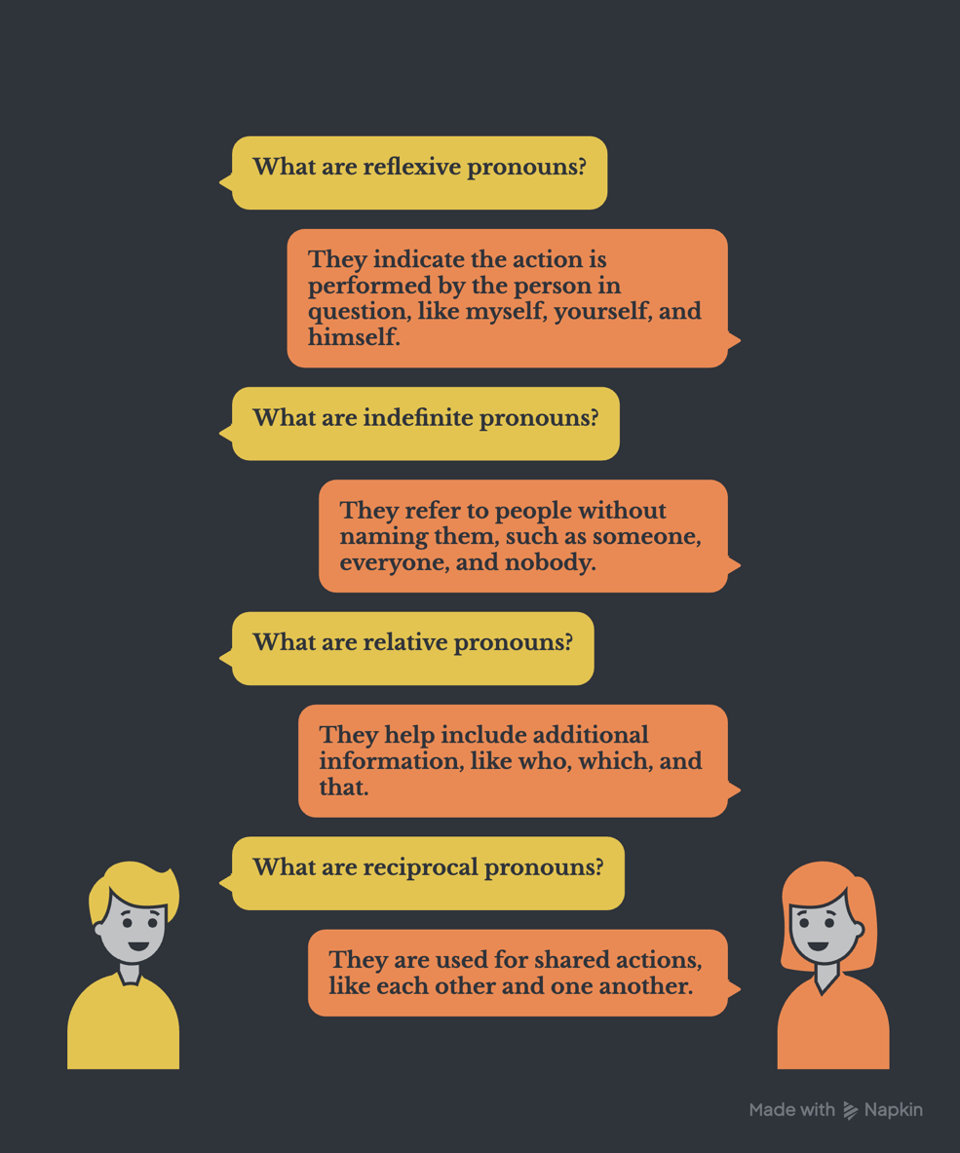 Next, introduce the indefinite pronouns, including someone, everyone, anyone, and nobody, so that the students can refer to people without naming any particular person.
Teach the relative pronouns who, which, and that to help students include additional information.
Finally, instruct them in using the reciprocal pronouns each other and one another when discussing shared actions.
In my class, the most significant change took place when the students started to take on the role of teachers. Following a technology failure, which disrupted the lesson we had planned, Rashid,* a usually quiet student from Somalia, put up his hand and asked, “Why don’t we teach you some of our languages?” and for the following 40 minutes, the students gave me phrases and grammatical patterns in Spanish, Somali, Swahili, Arabic, and Hindi.
The experience eventually became a weekly Language Ambassador session in which the students taught one another their home languages. As an example from real life of how to teach different kinds of pronouns, the students could describe what took place by writing:
-
- “Rashid suggested the activity himself.”
- “Everyone taught something.”
- “The students who took part shared their knowledge.”
- “They learned from each other.”
Activities to Try
-
-
- Rebuild With Pronouns: When reconstructing the pronoun stories, ask the students to give sentences that describe the Language Ambassador lesson, and then ask them to select between reflexive, indefinite, relative, or reciprocal pronouns; they must then explain how each pronoun makes the relationship clear.
- Teach Each Other: Ask the students to teach a word or grammatical feature from their own home language to a partner and then describe the interaction by using either each other or one another.
- Combine the Ideas: Give students two sentences that are related and ask them to join them together using who, which, or that. Then have the students read the combined sentences aloud to hear how the extra information improves communication.
-
2. Present Perfect Versus Simple Past
As your students have already studied regular and irregular action verbs, they are now in a position to compare the simple past and the present perfect; the simple past is used for actions that were completed at a specific time in the past, whereas the present perfect connects a past event or change to the present. Using timelines and everyday experiences can help students see this difference more clearly.
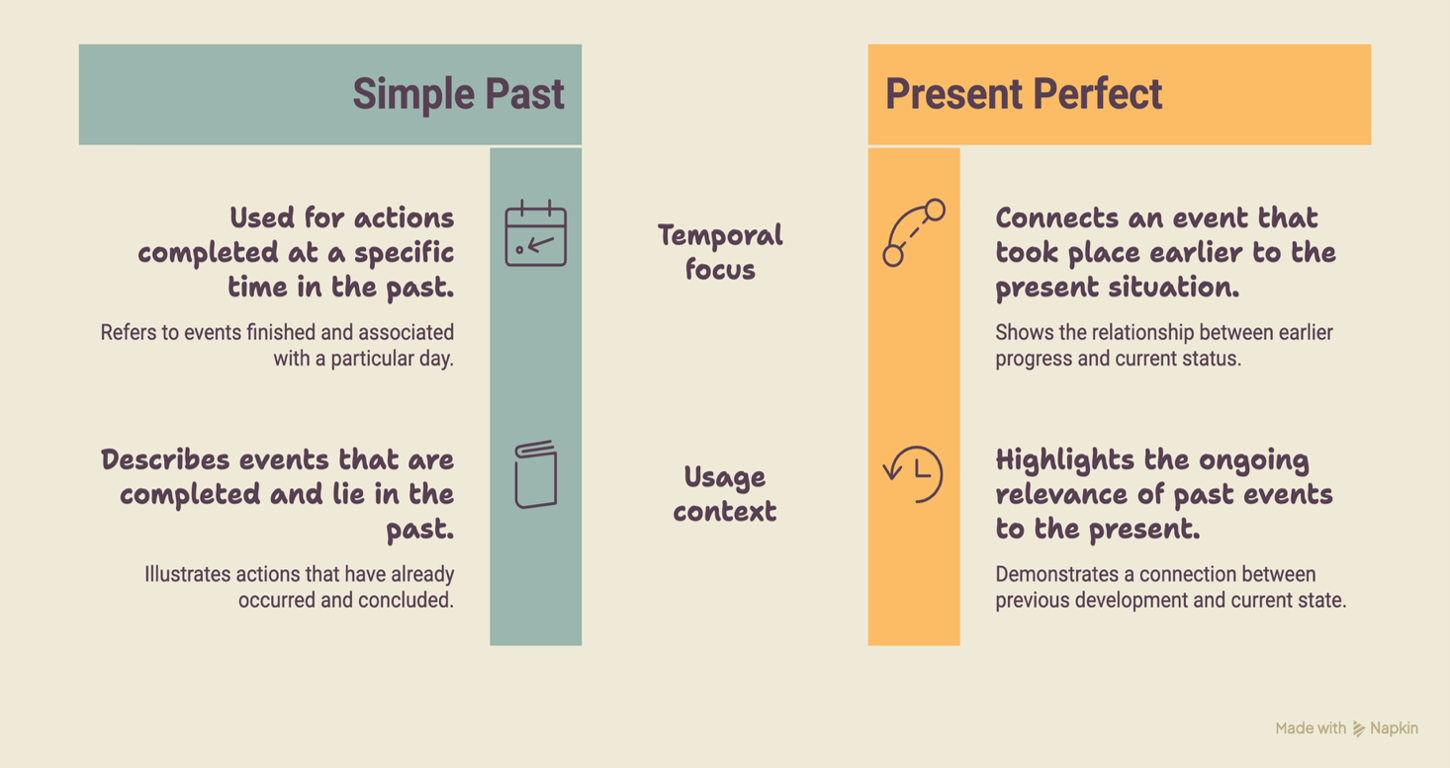
For example, you can use a classroom experience to show how a change in time perspective affects the verb tense. One Tuesday afternoon, a student named Elena, who was normally quiet, raised her hand during a sentence-building exercise. After speaking only in a whisper for 3 months, she confidently told us about her weekend: “Although it rained on Saturday, my family still went to the park.” Elena used the simple past because she was describing completed actions associated with a particular day.
But we can also describe Elena’s experience from a different time perspective. “Elena described her weekend on Tuesday” uses the simple past because the event is completed and situated at a specific time. In contrast, “Elena has become more confident in expressing her ideas” uses the present perfect because her growing confidence began in the past but is still relevant in the present.
Activities to Try
-
-
- Story Timeline: Have students put Elena’s actions in order and explain why the simple past is appropriate for each one. Then ask them to write a present-perfect sentence describing a change or experience that connects the past to the present.
- Experience Interview: Have students ask a partner a question beginning with “Have you ever …?” The partner answers using the present perfect, then adds details about a specific time using the simple past.
- Time-Marker Sort: Give students sentences containing time markers such as yesterday, last week, already, ever, and yet. Have them sort the sentences according to whether they use the simple past or present perfect and explain what clues helped them decide.
-
3. Converting Verbs Into Nominalizations
As your students develop their academic language, you can introduce nominalization, a common feature of academic writing. One way to create a nominalization is to change a verb into a noun. For example:
decide → decision
develop → development
educate → education
Nominalization allows students to express actions and processes as concepts, helping them use the more noun-based language common in academic writing.
To show students how this works, you can draw on familiar classroom experiences. In my book, I discuss Yuna, a student who earned her first B+ on an argumentative essay after practicing language structures in English class. She proudly brought her essay to class and pointed out that she had used both despite and furthermore, just as we had practiced.
Yuna’s experience can be described in two different ways. Students might compare “Yuna improved her writing” with “Yuna’s improvement was evident in her argumentative essay.” In the second sentence, the action improved becomes the noun improvement, shifting the emphasis from what Yuna did to the concept of her improvement. Similarly, students could rewrite “The teacher instructed the students” as “The instruction supported the students’ writing.” Comparing sentences like these helps students see how nominalization can shift action-based language toward the noun-based language they will encounter and use in academic texts.
Activities to Try
-
-
- Verb-Noun Match: Give students two mixed lists, one with verbs such as decide, develop, improve, and educate and another with their noun forms: decision, development, improvement, and education. Have them match each verb with its noun form, then, use each form in a sentence.
- Sentence Transformation: Give students a sentence containing a verb and have them rewrite it using the corresponding noun form. Ask them to compare the two sentences and discuss how the change affects the sentence’s structure and emphasis.
- Word Family Chart: Create a class chart of common verbs and their related nouns. As students encounter new word families in classroom texts, have them add the verb and noun forms to the chart.
-
Conclusion
Grammar lessons should continue to assist your students in expressing themselves more fully, in making connections, and in taking part in class more actively. Pronouns help to make the relationships clearer, verb tenses arrange our experiences over time, and nominalization enables students to move toward academic writing. All of these grammar tools are based on the foundation that we have developed in this series.
The cases of Rashid, Elena, and Yuna demonstrate that learning grammar is, in fact, a matter of personal development. Once students have clear language tools and the opportunity to practice, they begin to teach one another, share their experiences, and perform well in academic writing. Grammar acts as a link between what students already know and what they are learning to express with confidence.
*The names in the classroom stories are pseudonyms and do not correspond to any real students or teachers. Although the situations are based on actual experiences that took place in classrooms and on genuine instructional practices, specific details have been altered to respect the privacy of the individuals involved.

About the author
Karuna Dwivedi
Karuna Dwivedi, EdD, is an English language learning specialist, higher education educator, and author of Grammar as a Bridge: Empowering ELLs Through Writing and Speaking. She earned her doctorate in English language learning from National University and holds Cambridge CELTA and TESOL/TEFL certifications, with teaching experience from high school through university. Her research uses a qualitative phenomenological design with interpretative phenomenological analysis, grounded in culturally responsive pedagogy and Vygotsky’s sociocultural theory, to advance equitable, asset-based support for multilingual learners.